Reduce context cost
Shorten oversized conversation history and tool-heavy context before it reaches the provider, then record input tokens saved.
 SaveT
[Save Tokens]
SaveT
[Save Tokens]
SaveT = Save Tokens
SaveT is a multi-provider control layer for AI applications. It reduces provider cost by optimizing oversized context before billing, applies output budgets, blocks wasteful traffic when policy requires it, and records where tokens and money are spent.
Request budget controlled before provider billing
74k savedShorten oversized conversation history and tool-heavy context before it reaches the provider, then record input tokens saved.
Record model, provider, project, latency, status, input tokens, output budget, provider output, and billable savings.
Apply context windows, context modes, output reservations, rate limits, endpoint rules, provider allowlists, and tenant or key status checks.
Savings calculator
Use realistic traffic assumptions to estimate how context management can reduce input and output token cost. Percentages show the expected reduction from the selected management level.
Example benchmark
Aggregated public figures from a long-context Qwen 3.6 35B class benchmark focused on software engineering work. These numbers are examples, not guarantees; actual savings depend on workload shape and the chosen context mode.
Disclaimer: In our rigorous benchmark protocol, state-of-the-art models never reached a 100% quality score that would indicate completely error-free task outcomes. Quality percentages shown here are relative to a defined baseline, not an absolute claim of zero defects.
For AI operators
SaveT gives your team one place to manage context optimization, provider access, output budgets, usage visibility, billing exports, audit trails, and hard limits for the applications you operate.
Each proxied call records estimated input before and after SaveT, saved input tokens, context mode, provider, model, project, API key, status, latency, output budget, and billing fields.
SaveT can enforce context windows, shorten older history, prefer recent intent, reduce old tool-output pressure, and choose how aggressive the savings profile should be for each workload.
The same layer also controls output exposure, request rate, input-token throughput, payload size, provider access, endpoints, tenant status, and API-key status.
Tenant dashboard
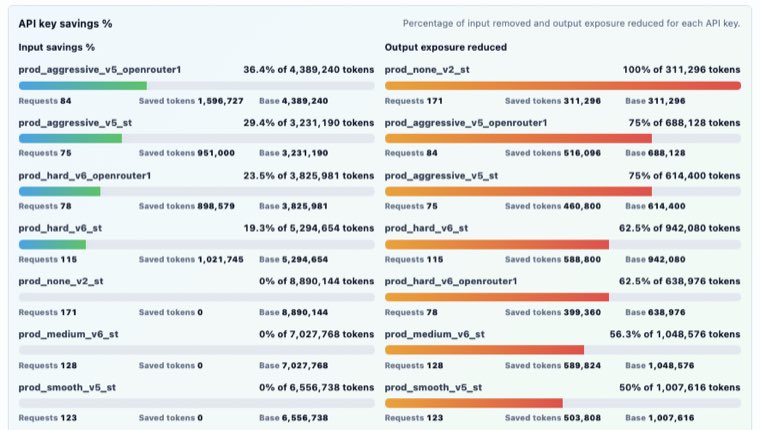
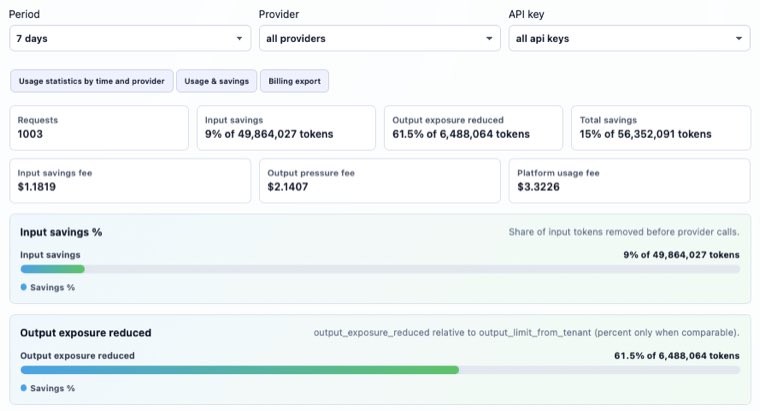
SaveT gives tenant teams a live operational view of token consumption, context savings, output exposure, provider usage, and billing impact. Instead of waiting for provider invoices, finance, product, and platform teams can see which API keys and providers are consuming budget and where optimization is working.
Track usage and savings by API key so each product, environment, customer, or workload can own its AI budget.
Compare estimated input before SaveT with input sent upstream and saved input tokens for each controlled traffic stream.
Combine usage monitoring with output-pressure fields, provider metadata, billing exports, audit logs, and policy controls.

How it works
SaveT estimates input tokens, reads the requested model, resolves tenant, project, API key, provider, endpoint, output budget, and context mode.
The platform checks tenant and key status, endpoint and provider rules, rate limits, payload limits, context window, output reservation, and context-mode behavior.
When the request is too large for the approved budget, SaveT compacts older context and tool-heavy history according to the selected smooth, medium, hard, or aggressive mode.
Allowed calls are routed upstream, policy failures are blocked before provider billing, and SaveT records usage, context savings, output exposure, provider output, errors, latency, billing fields, and audit data.
Context management levels
Different applications need different tradeoffs between context preservation and token savings. SaveT lets your organization select an active context mode for each project, then measure how that choice affects cost.
Use this mode when the model should retain as much useful context as possible while SaveT still reduces clear token waste.
Use this mode for everyday production workloads where token savings should be visible, but context preservation still matters.
Use this mode for high-volume or costly applications where reducing the LLM operating context is more important.
Use this mode for workloads with very large context, frequent requests, or strict cost pressure where the strongest reduction is acceptable.
Your organization can use different context levels across its own projects: smoother modes for quality-sensitive workloads, harder modes for high-volume cost control, and aggressive mode where maximum token savings matter most.
Capabilities
Reduce oversized LLM operating context before provider billing while preserving recent user intent, selected assistant history, tool-call integrity, and the workload's approved quality profile.
Track estimated input before and after SaveT, saved input tokens, output budget before and after control, provider output tokens, status, latency, provider, model, tenant, API key, and project.
Reserve, cap, or insert output-token budgets so response costs stay predictable instead of growing silently after input savings are achieved.
Route through OpenAI-compatible, Anthropic, Gemini, OpenRouter, hosted gateway, local backend, or custom provider configurations while recording provider and requested model metadata.
Choose the right level of context management per project, API key, application, or usage area, from quality-preserving modes to stronger cost-pressure modes.
Review usage counters, saved-token metrics, output-pressure billing fields, provider distribution, billing exports, and audit logs for operational and commercial reporting.
Why it matters
FAQ
These answers cover the current platform basics. This section is structured so it can grow as SaveT adds more providers, controls, and enterprise workflows.
SaveT sits between your application and the AI provider API. Instead of calling the provider directly, your application calls the SaveT endpoint, which is compatible with supported provider APIs. SaveT resolves tenant policy, estimates tokens, checks limits and provider rules, controls context and output budgets, forwards allowed calls upstream, blocks policy failures, and records economics for reporting.
SaveT effectiveness tests are not simple code-generation benchmarks or algorithm contests. They simulate software engineering work in a large monorepo, such as security and reliability audits, source-code reading, code search, test-log analysis, and security-report review through function calling and predefined tools. The evaluation focuses on factual consistency with tool outputs, repeatability of artificial landmarks, separation of domains such as authentication and payments, and required response format compliance, including structured outputs like JSON.
SaveT is designed as a multi-provider gateway for major AI APIs such as OpenAI, Anthropic, Gemini, OpenRouter, hosted gateways, local backends, and custom AI APIs. Provider availability depends on the configured account and integration scope.
For compatible APIs, the change is usually limited to replacing the provider base URL with the SaveT base URL, for example switching from a provider endpoint to https://app.savet.io/v1/. Existing request patterns can remain aligned with the supported provider API.
SaveT measures tokens saved before provider billing and charges a fraction of the cost those tokens would otherwise have created at the AI provider. Billing is handled in monthly cycles, and the management panel shows saved tokens and accrued charges as usage is recorded.
Yes. SaveT currently supports four context management levels: smooth, medium, hard, and aggressive. Teams can choose the level that best matches each project, balancing context preservation, quality sensitivity, request volume, and cost pressure.
SaveT currently records operational request economics such as estimated input before and after control, saved input tokens, output budget before and after control, provider output tokens, model, provider, project, API key, status, and latency. Deeper attribution such as system prompt, RAG context, tool output, and cache behavior should be treated as control and diagnostics areas, not as universally available per-request counters unless enabled in the integration scope.
SaveT protects data in transit and at rest. AI provider API keys are encrypted at rest with additional protection based on your private secret, so SaveT staff do not have direct access to those keys.
No. SaveT does not use customer prompts, responses, usage data, or stored configuration to train AI models.
Yes. You can stop using SaveT without cancellation fees by routing your application traffic back to your chosen AI provider endpoint.
Contact
Send your contact details and request content. The message will be delivered to savet@rsoft.pl.
Use it to optimize context, save input tokens before provider billing, enforce budgets, route provider traffic, and prove savings with operational reporting.